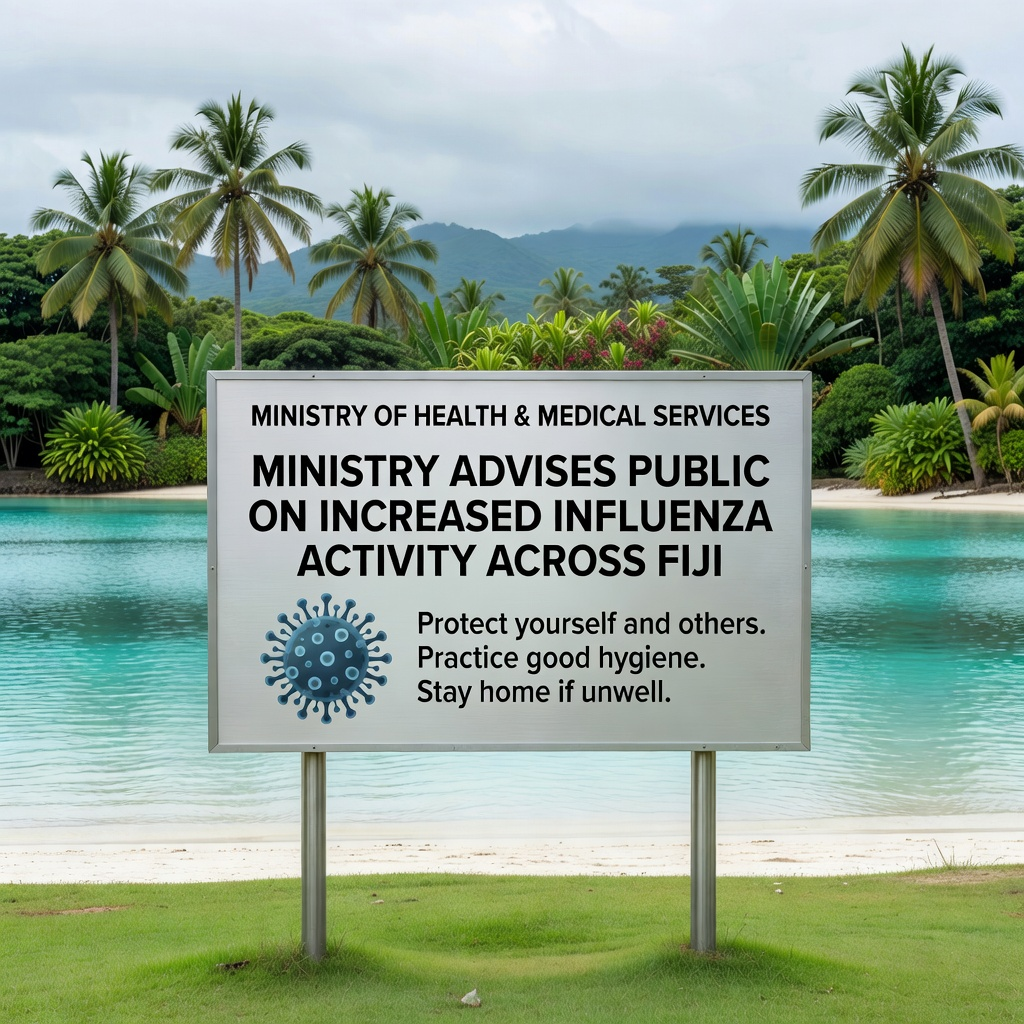

PUBLIC ADVISORY #37 | 3 September 2026.
The Ministry of Health and Medical Services (MoHMS) advises that an increase in influenza-like illnesses (ILI) and acute respiratory infections (ARI) is currently being observed across Fiji.
Recent surveillance data from the Fiji Centre for Disease Control (Fiji CDC), collected through the Early Warning Alert and Response Surveillance (EWARS) system, show a marked rise in ILI and ARI reports in the past three weeks.
Laboratory testing conducted at the National Public Health Laboratory (NPHL) also confirms an increase in test positivity of seasonal influenza.
Current Situation
The Ministry notes that this rise has occurred earlier in the year than the influenza wave Fiji experienced in the same period last year, mirroring early-season rises being observed in other countries in the Western Pacific Region, including New Zealand and Australia, as well as elsewhere in the Pacific.
Fiji’s current influenza trends are consistent with the wider regional and global picture, where elevated influenza activity is also being reported across parts of the Southern Hemisphere and Asia.
Public Health Response
In response to the increased influenza activity, the Ministry has:
- Enhanced influenza surveillance and laboratory testing through Fiji CDC and NPHL to track circulating strains.
- Alerted all Divisional and Subdivisional Health Teams to monitor ARI and ILI trends and reinforce infection prevention measures in health facilities.
- Continued to monitor the regional and global respiratory illness situation alongside in-country notifications.
Influenza Factsheet
What is influenza (“the flu”)?
Influenza is caused by influenza viruses, of which there are many different strains that change year to year. Some mild influenza symptoms like runny nose, sneezing, cough, or sore throat may be similar to the common cold, however, influenza is not the same as the common cold, as it can lead to serious disease such as pneumonia (inflammation of the lungs) especially in babies, people over age 60, pregnant women, people who have non-communicable diseases (e.g. lung disease, heart disease, kidney disease, diabetes), the obese, and those who smoke.
Symptoms
Fever, cough, sore throat, muscle/body aches, headache, fatigue, runny nose, sneezing, vomiting, and diarrhoea (more common in children).
While most people will develop these symptoms and recover in about 7–10 days, some may develop more serious illness that will require hospitalisation. Please immediately seek medical care if you develop any of the following symptoms:
Difficulty breathing or shortness of breath, pain or heaviness in the chest, inability to stay awake or confusion, or any other symptom of concern (e.g. severe vomiting).
How is it spread and how to protect yourself?
You can catch influenza when an infected person sneezes or coughs and you breathe it in, or if you have direct contact with, or touch, a surface or object that has flu virus on it and then touch your mouth, nose or eyes.
With influenza activity this high, everyone is asked to take the following precautions: cover your mouth and nose if you cough or sneeze while you are ill, wash your hands frequently with soap and water or use an alcohol-based hand sanitiser, avoid crowds where possible, stay home if you are sick, and use of a face mask in public if you are sick (to reduce spread) and anyone who wants to take extra precaution against getting infected you may wear a mask that covers your mouth and nose in crowded or enclosed public places and when visiting health facilities
Care for children with cold and flu symptoms
Keep your child hydrated
This helps reduce cold and flu symptoms and helps them feel better. Fevers can result in dehydration. Your child may not feel as thirsty as they normally would, and they may be uncomfortable when drinking, so it is important to encourage them to drink plenty of fluids like fresh fruit juices and water (e.g. lemon juice).
Dehydration can be very serious in babies, especially if they’re under 3 months old. Go immediately to your nearest health centre or doctor if you suspect your baby is dehydrated. Some signs may include:
- no tears when crying
- dry lips
- the soft spot on the head appears sunken-in
- decreased activity
- urinating less than three to four times in 24 hours
If your child is breastfed, attempt to breastfeed them more frequently than usual. Your baby may be less interested in breastfeeding if they’re sick. You may have to have several short feeding sessions or express breast milk and give it in a small cup in order for them to consume enough fluid.
Clear up stuffed nasal passages and loosen mucous to ease cough
- Careful use of a steam source in a closed room can help to relieve a stuffed nose and soften mucous to make coughing up mucous easier.
- Saline drops for the nose can also be bought at pharmacies to soften nasal mucous and facilitate its discharge.
- Alternatively, use a small amount of Vicks rub mixed with oil over the heels of the feet for children over 3 months old.
- If your child is over 1 year old, try giving honey for a cough instead of medication. You can give 2 to 5 millilitres (mL) of honey a few times during the day.
Encourage rest
Extra rest can help your child recover faster.
Fever
Your child may be very hot due to fever. Dress them lightly and avoid heavy blankets or excessive layers that could make them feel hotter. A mild fever does not need treatment, as fever is the body’s way of fighting off an infection. A lukewarm bath can also help them cool off and wind down before taking a nap or going to sleep for the night.
Seek medical care
Sometimes even the best at-home care isn’t enough to help your little one make a full recovery. Seek medical care right away if your child:
- has a fever greater than 38°C for more than two days, or a fever of 40°C or higher for any amount of time
- has a fever of 38°C or higher and is under 3 months old
- has a fever that doesn’t get better after taking Panadol
- seems unusually drowsy or lethargic
- won’t eat or drink
- is wheezing or is short of breath
ENDS