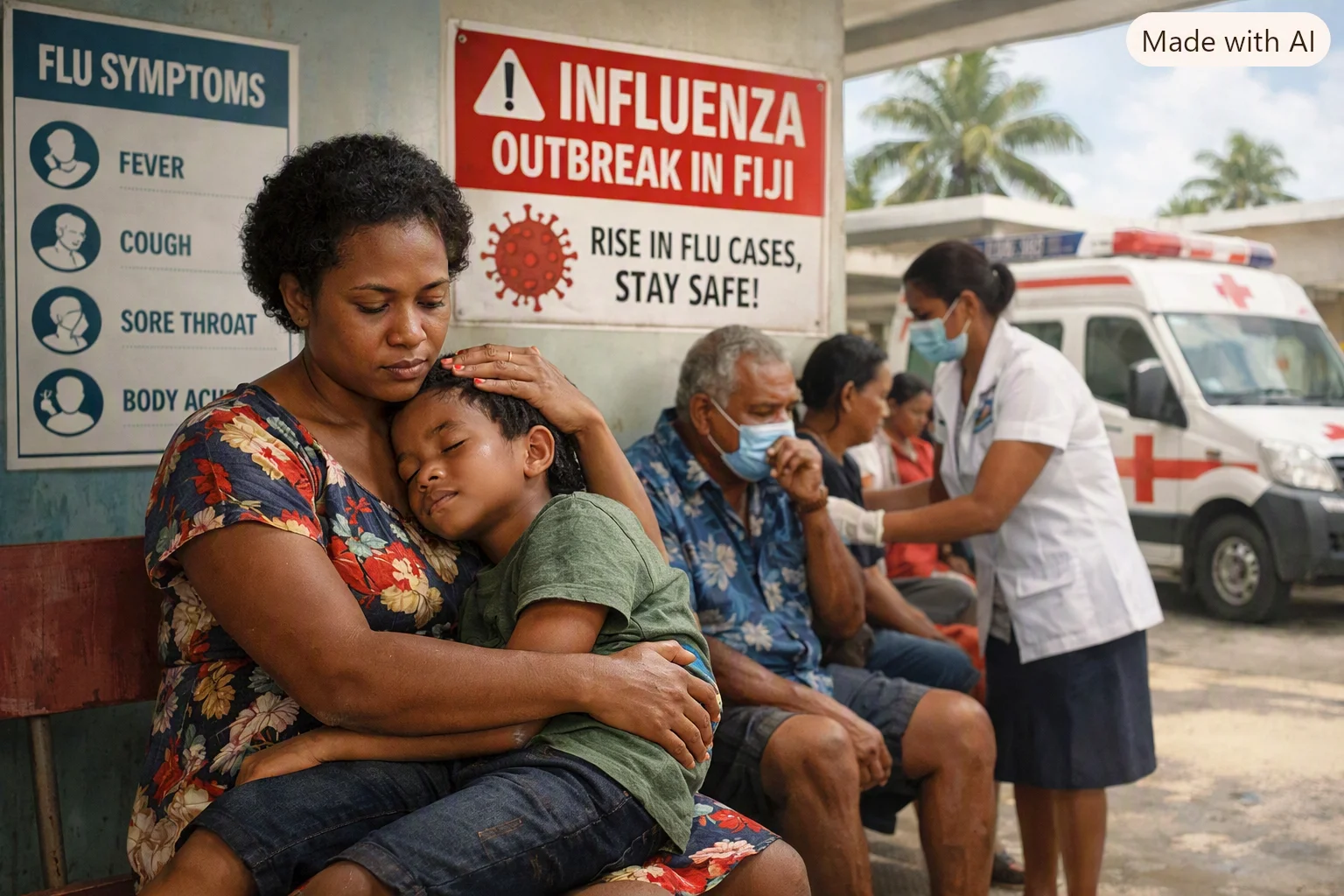
Influenza Cases Continue to Rise Across Fiji

PUBLIC ADVISORY #39 | 18 September 2026.

The Ministry of Health & Medical Services is urging the public to take extra health precautions following a sharp increase in flu cases across the country. 

The latest respiratory health report, covering the first nine months of the year (January to September 2026), shows that sickness from flu-like viruses is rising quickly.

In the first week of September alone, health centers recorded 1,780 new cases of influenza-like illness (ILI). This is a massive 75 percent jump in sickness compared to just the week before.

Health data shows that the Central Division is currently the hardest-hit area in Fiji, recording the highest number of flu cases with 975 patients seeking care in a single week. 

The Northern Division followed with 398 cases, while the Western Division recorded 362 cases.

The report also reveals that children under 5 years old are the most affected age group. 

This young group makes up 30 percent of all flu-like cases nationwide. 

In the Northern Division, young children accounted for 30 percent of the local cases, while in the Central Division, they made up 24 percent.

Laboratory tests from January to September confirm that a specific flu strain, Influenza A (H1pdm09), is the main virus causing the current outbreak. 

Furthermore, an online public health tracker called FluTracking showed that the number of everyday citizens reporting both a cough and a fever spiked from 10.2 percent to 16.4 percent in one week.

What is the Flu?

The flu (influenza) is a contagious respiratory illness caused by viruses. While it can feel like a common cold, the flu is much more serious. It can lead to severe lung infections like pneumonia, especially for vulnerable groups:

  • Babies and young children;
  • Adults over 60 years old;
  • Pregnant women;
  • People with medical conditions (like diabetes, asthma, heart, or kidney disease);
  • Smokers and individuals with obesity;

Common Symptoms

Most people recover in 7 to 10 days. Typical symptoms include:

  • Fever, headache, and body aches
  • Cough and sore throat
  • Runny or stuffed nose and sneezing
  • Extreme tiredness (fatigue)
  • Vomiting and diarrhoea (mostly in children)

Seek emergency medical care immediately if you experience difficulty breathing, chest pain, severe vomiting, confusion, or severe drowsiness.

How to Protect Yourself and Others

The flu spreads through coughs, sneezes, and touching infected surfaces. Protect your community by following these steps:

  • Wash hands often with soap and water or use hand sanitizer;
  • Cover your mouth and nose  with a tissue or your elbow when coughing or sneezing;
  • Stay home if you are feeling sick;
  • Wear a mask if you are sick and need to go out;

Caring for Sick Children at Home

1. Keep Them Hydrated

Fevers cause dehydration, which can be dangerous for babies.

  • Encourage your child to drink plenty of water and fresh fruit juices (like lemon juice).
  • If breastfeeding, offer shorter, more frequent feeds. You can also express milk and feed it from a cup if they refuse the breast.
  • Watch for dehydration signs: Dry lips, no tears when crying, a sunken soft spot on the head, low energy, or fewer than 3–4 wet nappies in 24 hours. See a doctor immediately if you notice these.

When to Take Your Child to the Doctor

Take your child to a health centre immediately if they:

  • Are under 3 months old and have a fever of 38°C or higher;
  • Have a fever over 38°C for more than two days, or any fever reaching 40°C or higher;
  • Have a fever that does not drop after consulting a healthcare provider regarding fever management;
  • Are unusually drowsy, lethargic, or refuse to eat or drink;
  • Are wheezing or struggling to breathe;

ENDS

VUNISEA HOSPITAL MORTUARY PROJECT IN PROGRESS

PUBLIC ADVISORY # 33 | 1 June 2026.

The Ministry of Health and Medical Services is currently working on the contract documentation for the Vunisea Hospital Mortuary Project in Kadavu after approval from the Government Tender Board (GTB). The Vunisea Hospital Morgue is part of the nine mortuary projects approved by the GTB for upgrades. Part of the upgrade will include the;

  • Removal of the old mortuary unit;
  • Renovation of the mortuary infrastructure;
  • Supply, installation and commissioning of two berth units and associated modern equipment;
  • Installation of the new switchboard and circuit breakers which also include waterproof power points;
  • Training of staff to maintain these units;

Each project is expected to take 6-8 months to complete after the signing of the contract and initial payment. The Vunisea Hospital Morgue is currently non-operational due to the challenges with consistent power supply at Vunisea Government Station in Kadavu. The Ministry sympathises with members of the public in the province of Kadavu for the inconvenience caused in burying their loved ones.

ENDS

FIJIANS URGED TO AVOID TRAVEL TO A FEW CENTRAL AFRICAN COUNTRIES

PUBLIC ADVISORY # 32 | 25 May 2026.

The Ministry of Health and Medical Services advises Fijians to avoid non-essential travel to the Democratic Republic of the Congo, Uganda, and neighbouring countries with shared land borders, including South Sudan, Kenya, Tanzania, Rwanda, Burundi, Zambia, Angola, the Republic of the Congo, and the Central African Republic. Anyone travelling to these destination is advised to take precautions to avoid possible exposure to Ebola Disease by:

  • Avoiding contact with sick individuals;
  • Avoiding contact with animals in forested areas;
  • Avoiding the consumption of bushmeat or wild animal meat; and
  • Practicing good personal hygiene and regular handwashing.

Travelers should also monitor themselves for symptoms while in affected countries and for 21 days after leaving. Signs and Symptoms Travelers returning from affected countries should monitor themselves for symptoms for 21 days after departure from the affected countries.

Symptoms may include:

  • Fever;
  • Severe headache;
  • Muscle pain;
  • Weakness or fatigue;
  • Sore throat;
  • Vomiting or Diarrhoea;
  • Rash; and
  • Unexplained bleeding or bruising.

Anyone who develops symptoms during this monitoring period should immediately self-isolate and contact their nearest health facility or local health authority by telephone for advice. Early notification will help healthcare workers safely assess and manage suspected cases while protecting others from possible exposure. The Ministry is also working closely with partner agencies at international points of entry, including Nadi International Airport, to implement targeted health screening and follow-up measures for travellers who have visited affected countries within 21 days prior to arrival in Fiji. The Ministry will continue to monitor the global situation closely, maintain surveillance for early detection of any cases, and work with World Health Organisation and partner agencies to adapt the national response as necessary.

The Ministry is currently reviewing and monitoring the global situation on the Ebola Disease and is updating necessary prevention, preparedness, response plans and protocols that will be implemented should the need arise. These measures include strengthened surveillance and case identification, review of border health protocols at international points of entry, preparedness for laboratory testing of suspected cases, and review of infection prevention and control and case management protocols. Although the risk to Fiji from this Ebola outbreak remains low, preparedness is a necessary proactive measure. The Ministry is also liaising with relevant agencies to determine whether any Fijian nationals are currently in the affected areas.

These measures are in place after the WHO declaration of a Public Health Emergency of International Concern (PHEIC) for Ebola Disease in the Democratic Republic of Congo and Uganda last week. The declaration also stated that the outbreak does not meet the criteria for a pandemic emergency, which is the highest level of global alert. As of 22nd May 2026, Uganda has reported two confirmed cases of Bundibugyo virus disease (BVD) both linked to areas in the Democratic Republic of the Congo where BVD transmission has been documented. BVD is a rare species of the Ebola Virus. The WHO has assessed the risk as “Very High” for the Democratic Republic of the Congo and “High” for Uganda as of 22 May 2026.

WHO has also noted that the epidemiological situation differs between the two countries in terms of the scale of the outbreak and the context in which response efforts are being implemented. According to WHO reports the Democratic Republic of the Congo had recorded a total of 516 suspected Ebola cases, of which 33 had been laboratory confirmed. In addition, 131 suspected deaths had been reported, including four confirmed deaths.

TAVUA HOSPITAL MORTUARY TO BE RENOVATED

PUBLIC ADVISORY # 31 | 22 May 2026.

The Ministry of Health and Medical Services wishes to advise members of the public that the Tavua Hospital mortuary will be closed from Monday 25th May until Friday June 12th, 2026 for renovations.

Therefore, the Ministry urge members of the public to take their deceased loved ones to the Ba Aspen Hospital or other health care facilities with morgue services nearby.

The Ministry apologises for any inconvenience caused during this time.

ENDS

MINISTRY MONITORS SPREAD OF HANTAVIRUS

PUBLIC ADVISORY # 30 | 11 May 2026.

The Ministry of Health & Medical Services, continues to monitor the outbreak of Hantavirus on the Hondius cruise ship now anchored off Tenerife in Spain’s Canary Islands.

The Fiji Centre for Disease Control (FCDC) at the Ministry understands that eight (8) cases have been identified, with three (3) deaths and they will continue to monitor the situation.

No cases have been reported to date in Fiji, and none of the cruise ship passengers are from Fiji.

The risk to Fiji from this cruise ship outbreak is very low.

As part of standard protocols, in-line with international requirements, all ships at international ports of entry in Fiji are subject to strict health declaration and inspection requirements, before clearance for entry in order to prevent the spread of infectious diseases.

These include the production of Ship Sanitation Certificates (which include information on de-ratting) and Maritime Declaration of Health identifying sick passengers on board.

These standard protocols for ships at ports of entry include the boarding of vessels for inspection by Environmental Health Officers of the Ministry of Health and Medical Services and escalation in line with contingency plans as needed.

The Ministry also has in place surveillance systems for the reporting of infectious diseases, and protocols at international ports of entry for the isolation and treatment of sick passengers, including through our Border Health Protection Unit in Nadi as needed.

Hantavirus is a rare and serious disease transmitted to humans through exposure to the urine, faeces and saliva of infected rodents like rats or mice.

It is not easily spread from human to human, however, the Andes strain causing the cruise ship outbreak has been shown to transmit amongst close contacts.

ENDS