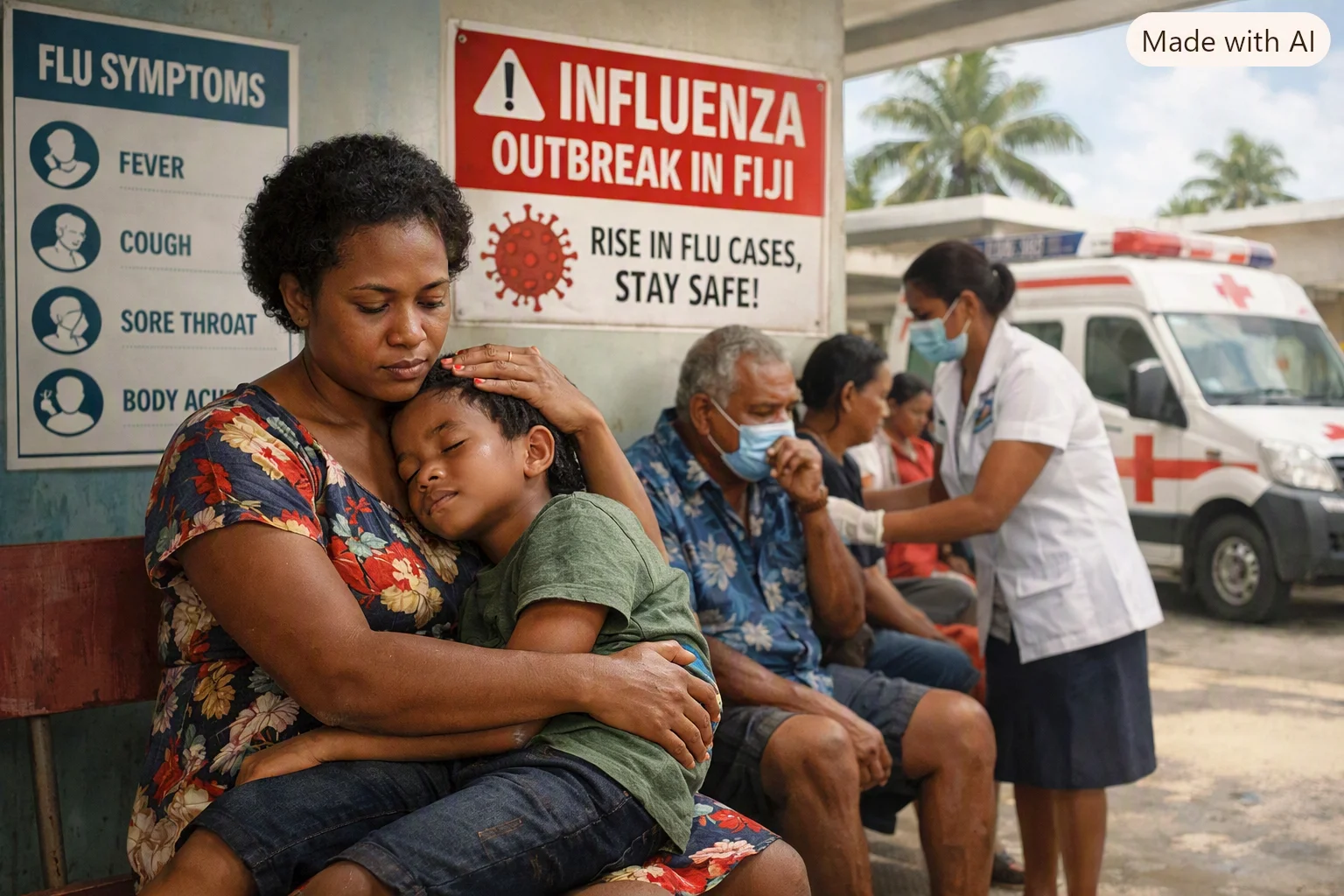
Influenza Cases Continue to Rise Across Fiji

PUBLIC ADVISORY #39 | 18 September 2026.

The Ministry of Health & Medical Services is urging the public to take extra health precautions following a sharp increase in flu cases across the country. 

The latest respiratory health report, covering the first nine months of the year (January to September 2026), shows that sickness from flu-like viruses is rising quickly.

In the first week of September alone, health centers recorded 1,780 new cases of influenza-like illness (ILI). This is a massive 75 percent jump in sickness compared to just the week before.

Health data shows that the Central Division is currently the hardest-hit area in Fiji, recording the highest number of flu cases with 975 patients seeking care in a single week. 

The Northern Division followed with 398 cases, while the Western Division recorded 362 cases.

The report also reveals that children under 5 years old are the most affected age group. 

This young group makes up 30 percent of all flu-like cases nationwide. 

In the Northern Division, young children accounted for 30 percent of the local cases, while in the Central Division, they made up 24 percent.

Laboratory tests from January to September confirm that a specific flu strain, Influenza A (H1pdm09), is the main virus causing the current outbreak. 

Furthermore, an online public health tracker called FluTracking showed that the number of everyday citizens reporting both a cough and a fever spiked from 10.2 percent to 16.4 percent in one week.

What is the Flu?

The flu (influenza) is a contagious respiratory illness caused by viruses. While it can feel like a common cold, the flu is much more serious. It can lead to severe lung infections like pneumonia, especially for vulnerable groups:

  • Babies and young children;
  • Adults over 60 years old;
  • Pregnant women;
  • People with medical conditions (like diabetes, asthma, heart, or kidney disease);
  • Smokers and individuals with obesity;

Common Symptoms

Most people recover in 7 to 10 days. Typical symptoms include:

  • Fever, headache, and body aches
  • Cough and sore throat
  • Runny or stuffed nose and sneezing
  • Extreme tiredness (fatigue)
  • Vomiting and diarrhoea (mostly in children)

Seek emergency medical care immediately if you experience difficulty breathing, chest pain, severe vomiting, confusion, or severe drowsiness.

How to Protect Yourself and Others

The flu spreads through coughs, sneezes, and touching infected surfaces. Protect your community by following these steps:

  • Wash hands often with soap and water or use hand sanitizer;
  • Cover your mouth and nose  with a tissue or your elbow when coughing or sneezing;
  • Stay home if you are feeling sick;
  • Wear a mask if you are sick and need to go out;

Caring for Sick Children at Home

1. Keep Them Hydrated

Fevers cause dehydration, which can be dangerous for babies.

  • Encourage your child to drink plenty of water and fresh fruit juices (like lemon juice).
  • If breastfeeding, offer shorter, more frequent feeds. You can also express milk and feed it from a cup if they refuse the breast.
  • Watch for dehydration signs: Dry lips, no tears when crying, a sunken soft spot on the head, low energy, or fewer than 3–4 wet nappies in 24 hours. See a doctor immediately if you notice these.

When to Take Your Child to the Doctor

Take your child to a health centre immediately if they:

  • Are under 3 months old and have a fever of 38°C or higher;
  • Have a fever over 38°C for more than two days, or any fever reaching 40°C or higher;
  • Have a fever that does not drop after consulting a healthcare provider regarding fever management;
  • Are unusually drowsy, lethargic, or refuse to eat or drink;
  • Are wheezing or struggling to breathe;

ENDS

MINISTRY MONITORS SPREAD OF HANTAVIRUS

PUBLIC ADVISORY # 30 | 11 May 2026.

The Ministry of Health & Medical Services, continues to monitor the outbreak of Hantavirus on the Hondius cruise ship now anchored off Tenerife in Spain’s Canary Islands.

The Fiji Centre for Disease Control (FCDC) at the Ministry understands that eight (8) cases have been identified, with three (3) deaths and they will continue to monitor the situation.

No cases have been reported to date in Fiji, and none of the cruise ship passengers are from Fiji.

The risk to Fiji from this cruise ship outbreak is very low.

As part of standard protocols, in-line with international requirements, all ships at international ports of entry in Fiji are subject to strict health declaration and inspection requirements, before clearance for entry in order to prevent the spread of infectious diseases.

These include the production of Ship Sanitation Certificates (which include information on de-ratting) and Maritime Declaration of Health identifying sick passengers on board.

These standard protocols for ships at ports of entry include the boarding of vessels for inspection by Environmental Health Officers of the Ministry of Health and Medical Services and escalation in line with contingency plans as needed.

The Ministry also has in place surveillance systems for the reporting of infectious diseases, and protocols at international ports of entry for the isolation and treatment of sick passengers, including through our Border Health Protection Unit in Nadi as needed.

Hantavirus is a rare and serious disease transmitted to humans through exposure to the urine, faeces and saliva of infected rodents like rats or mice.

It is not easily spread from human to human, however, the Andes strain causing the cruise ship outbreak has been shown to transmit amongst close contacts.

ENDS

HANTAVIRUS

Hantaviruses are zoonotic viruses that naturally infect rodents and can occasionally spread to people.

Key facts

  • Hantaviruses are a group of viruses carried by rodents that can cause severe disease in humans.
  • People usually get infected through contact with infected rodents or their urine, droppings or saliva.
  • Infection with hantaviruses can cause a range of illnesses, including severe disease and death.
  • In the Americas, hantaviruses can cause hantavirus cardiopulmonary syndrome (HCPS), a severe respiratory illness, with a case fatality rate up to 50%.
  • Andes virus, found in South America, is a currently known hantavirus for which limited human‑to‑human transmission among contacts has been documented.
  • In Europe and Asia, hantaviruses cause haemorrhagic fever with renal syndrome (HFRS).

Hantavirus

MOSQUITO SPRAYING PROGRAM – SAVUSAVU RESIDENTS

PUBLIC ADVISORY # 27 | 28 April 2026.

The Ministry of Health & Medical Services wishes to inform all residents mentioned below that our Health Inspectors at the Savusavu Health Office will be conducting mosquito spraying from today – Tuesday 28/04/2026 until Thursday 30/04/2026.

DateTimeTarget Area
Tuesday 28.04.265pm – 7pmVuiyasawa Settlement, Provincial Office Compound, Savusavu Police Station
Wednesday 29.04.265am – 7amYaroi Village, Nasavusavu District School Compound
 5pm – 7pmNabauto Govt Quaters, Savusavu Hospital Compound, NFA Compound
Thursday 30.04.265am – 7am Naqere Area
 5pm – 7pmKetei, Savudrodro village, Savarekareka, WAF , RPA, St Bedes Dorm, St Andrews Primary School, St Bedes Secondary School Compound

Ketei, Savudrodro village, Savarekareka, WAF , RPA, St Bedes Dorm, St Andrews Primary School, St Bedes Secondary School Compound This initiative is part of our ongoing efforts to reduce mosquito population and prevent the spread of mosquito-borne diseases such as dengue fever.

Important Information for Residents:

  • The insecticide in the fog is not harmful to human at the low concentration used and it has no odour.
  • Fogging operations are conducted in the early morning or late afternoon as this is the time when the outdoor dengue mosquito vector is most active.
  • Residents are advised not to be concerned about the fog and are also requested to leave their doors and windows open when the fogging machine is in their area, so that the fog can kill mosquitoes in the homes.
  • Residents are also advised to continue destroying dengue mosquitoes breeding places in their yard and to protect themselves and their family from mosquito bites.

 The Ministry looks forward to the co-operation of community members listed above in ensuring the success of this program. 

Together, we can create a healthier and safer environment.

For further information, please contact: Ministry of Health and Medical Services on 3306177 or Toll Free number 158.

ENDS

MINISTRY URGES GENERAL PUBLIC TO TAKE PRECAUTION AGAINST LEPTOSPIROSIS

PUBLIC ADVISORY # 17 | 22 February 2026.

The Ministry of Health and Medical Services is urging the general public to take immediate precautionary measures following a recent death and admissions with suspected severe leptospirosis last week.

This is after the Ministry admitted three (3) teenagers in healthcare facilities around Suva, suspected of having leptospirosis. One of the three teenagers died upon being admitted at the Colonial War Memorial Hospital on Friday and the Ministry sends its condolences to the family.
All three cases have a history of swimming at Colo-i-Suva early this month.
Meanwhile, the Central Health Services Divisional Outbreak Response Team are carrying out their public health interventions and investigations.

The Ministry stresses that although current leptospirosis case reports may be low, it is still a deadly disease and therefore the need for public awareness and prevention measures.
The recent death highlights the ongoing risk, especially after periods of heavy rain and with these weather conditions more cases are to be expected. Leptospirosis is preventable and treatable if detected early. The Ministry urges everyone to take precautions seriously and seek medical care immediately if unwell.